General
Who's Responsible for Protecting CUI? A Comparative Analysis
Published May 27, 2026
Introduction
Mishandling Controlled Unclassified Information (CUI) can lead to significant legal and financial repercussions for organizations, making its protection a critical priority across various sectors. This article will explore the distinct responsibilities organizations have in protecting CUI, focusing on how various industries, including defense, healthcare, and finance, approach compliance and security. Organizations must adopt comprehensive strategies to ensure compliance and security of CUI, addressing the pressing question of who bears the responsibility for its protection and what best practices can mitigate risks.
Define Controlled Unclassified Information (CUI)
Entities managing Controlled Unclassified Information (CUI) must navigate a complex landscape of regulations and security protocols. CUI pertains to sensitive yet unclassified material generated or held by the U.S. government, necessitating safeguarding or dissemination controls in accordance with relevant laws, regulations, or government-wide policies. It includes various types of sensitive data, such as personal information, proprietary business details, and critical infrastructure information. The CUI program aims to standardize the handling of such data across federal agencies, ensuring adequate protection from unauthorized access and disclosure.
It’s crucial for organizations handling CUI to fully understand its implications, as this knowledge determines the required security protocols and adherence obligations they must follow. As stated by GSA, “GSA requires the applicable IT security and privacy requirements outlined in its IT Security Procedural Guide 09-48 to be incorporated into contract solicitation documents.” Furthermore, CUI Specified is defined as CUI that has a law, regulation, or government-wide policy requiring stricter controls beyond the baseline protections outlined in NIST 800-171. In contrast, CUI Basic contains the baseline handling and dissemination controls as identified in the Final Rule issued by NARA on November 14, 2016.
Additionally, organizations must provide training, as highlighted by the quote, “DoD Mandatory CUI Training educates personnel on handling, protection, and dissemination of Controlled Unclassified Information.” Understanding and adhering to CUI regulations is not just a compliance issue; it is crucial for maintaining organizational integrity and trust.
 at the center. Each branch represents a key area related to CUI, such as its definition, types, and regulations. Follow the branches to explore how these areas connect and what they entail.”)
Compare Roles in CUI Protection Across Industries
It is essential to identify whos responsible for protecting CUI, as this critical responsibility varies significantly across different industries. In the defense sector, the Department of Defense (DoD) enforces stringent adherence to CUI regulations, mandating that military personnel, civilians, and contractors follow specific safeguarding protocols. This includes the implementation of security controls outlined in NIST SP 800-171 Revision 3, which is critical for maintaining eligibility for DoD contracts. Non-compliance with these standards jeopardizes contract eligibility, preventing defense contractors from bidding on DoD contracts.
In healthcare, compliance with the Health Insurance Portability and Accountability Act (HIPAA) is crucial for protecting patient information. HIPAA regulates the safeguarding of patient information, including CUI, necessitating healthcare entities to adopt strong security measures to protect sensitive data. The typical expense of a data breach in healthcare environments is roughly $4.88 million, and non-adherence increases an average of $174,538 to the expense of a data breach in contrast to compliant entities, highlighting the financial risks associated with upholding standards.
Financial institutions are similarly bound by stringent regulations, such as the Gramm-Leach-Bliley Act (GLBA), which dictates how they must handle sensitive customer data. Not adhering to regulations in this sector can lead to hefty penalties, with the total expense of non-adherence averaging $14.82 million, compared to $5.47 million for upholding regulations. Furthermore, entities are increasingly acknowledging the significance of adherence, with 82% intending to boost their investment in regulatory technology in 2026.
This comparative analysis highlights the tailored approaches each industry adopts for CUI protection, driven by the nature of the information they handle and the specific regulatory requirements they face. Moreover, the anticipated C3PAO backlog of 24-30 months by late 2026 highlights the urgency for entities to manage their adherence timelines effectively. Understanding whos responsible for protecting cui is essential for organizations that aim to safeguard sensitive information and maintain compliance.
 . Each branch represents an industry, and the sub-branches detail the specific regulations and responsibilities they have. The colors help distinguish between the sectors, making it easier to see how they compare.”)
Examine Implications of CUI Protection Responsibilities
Entities that fail to safeguard Controlled Unclassified Information (CUI) face significant legal, financial, and reputational risks. Legal actions may arise from mishandling CUI, leading to substantial fines and penalties, particularly if unauthorized access to sensitive information occurs.
The financial implications of data breaches are staggering. In the U.S., the average cost of a data breach is projected to reach $10.22 million by 2025, with entities incurring remediation costs, loss of contracts, and potential litigation expenses. Notably, breaches that take longer than 200 days to identify and contain can cost an average of $5.01 million, emphasizing the critical need for timely detection and response.
Reputational harm is equally significant. Entities who are responsible for protecting CUI and do not adequately fulfill this duty risk losing the confidence of clients and stakeholders, which can have lasting effects on their business operations. Moreover, regulatory authorities may impose stricter oversight on entities that consistently fail to adhere to compliance standards, complicating their operational environment. For instance, entities with inadequate regulatory compliance face average breach costs of approximately $4.62 million for each incident.
Additionally, it is crucial to recognize that 88% of all cyber incidents are attributed to human errors, underscoring the necessity for robust employee training and awareness programs. Entities must understand who is responsible for protecting CUI to prioritize cybersecurity and effectively mitigate data breach risks.
 . Each main box represents a type of risk, and the sub-boxes detail specific consequences that can arise from mishandling CUI. Follow the arrows to see how these risks are interconnected.”)
Identify Best Practices for Safeguarding CUI
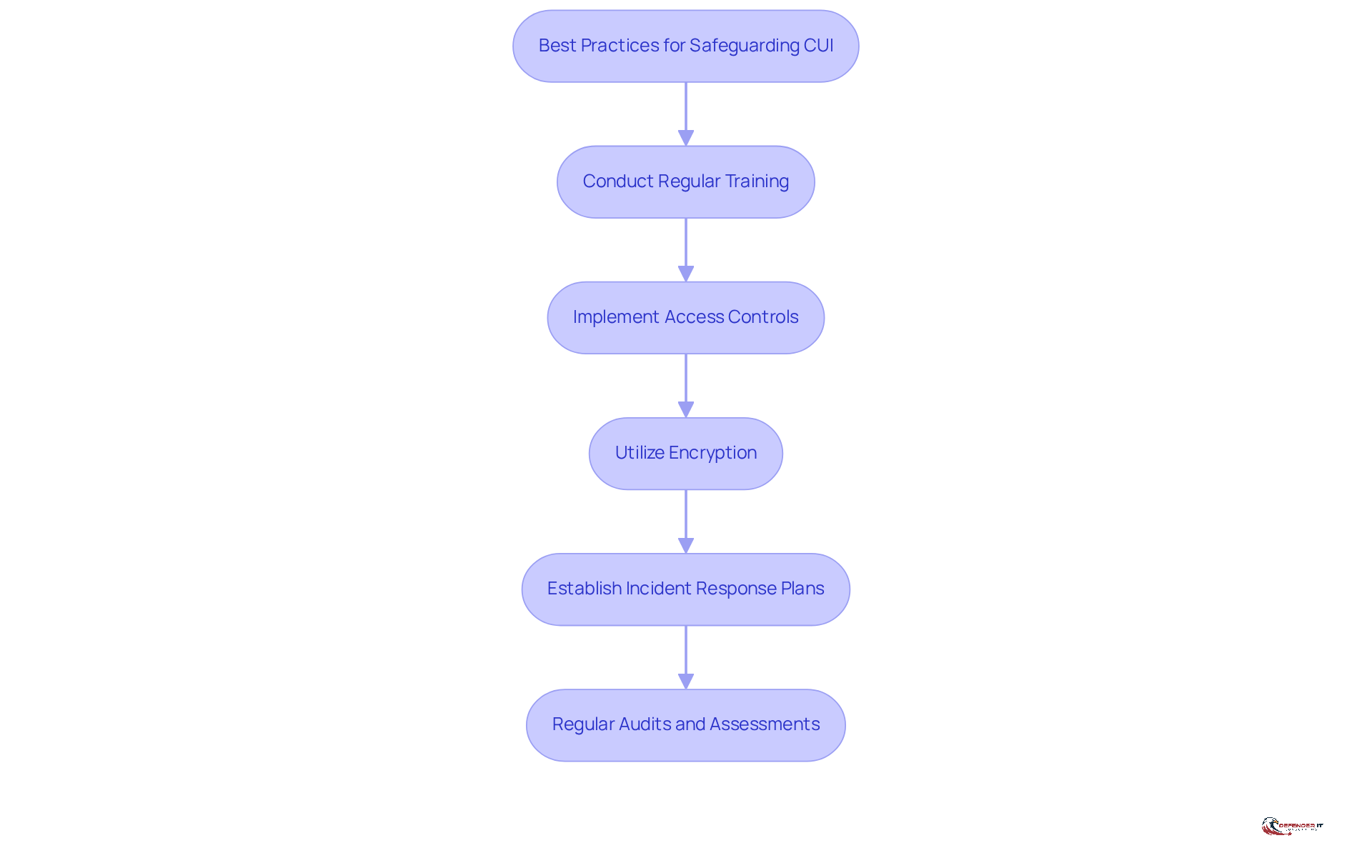
Organizations face significant risks in safeguarding Controlled Unclassified Information (CUI) without a structured approach to data protection, highlighting who’s responsible for protecting CUI. To effectively protect CUI, organizations need to clarify who’s responsible for protecting CUI and implement a series of best practices tailored to their specific operational contexts. Key practices include:
- Conduct Regular Training: Ensure that all employees handling CUI receive comprehensive training on the importance of protecting this data and the specific protocols they must follow. As Henry Ford famously said, it’s better to train your employees and have them leave than to not train them and have them stay, highlighting the critical need for effective training.
- Implement Access Controls: Limit access to CUI to only those individuals who require it for their job functions, utilizing role-based access controls to enforce this principle.
- Utilize Encryption: Encrypt CUI both at rest and in transit to protect it from unauthorized access and breaches. This technical measure is essential for maintaining the integrity of sensitive information.
- Establish Incident Response Plans: Develop and regularly update incident response plans to address potential breaches of CUI, ensuring that all stakeholders know their roles in the event of a security incident.
- Regular Audits and Assessments: Conduct periodic audits and risk assessments to identify vulnerabilities in CUI handling processes and implement necessary improvements. Ken Blanchard’s case study on “Connecting Roles to Organizational Goals” illustrates how aligning training with organizational objectives enhances security measures. It is essential for organizations to determine who’s responsible for protecting CUI effectively by implementing these best practices and avoiding the risks associated with non-compliance.
Conclusion
The protection of Controlled Unclassified Information (CUI) is a critical responsibility that organizations must navigate in an increasingly complex regulatory environment. This article has explored the intricate landscape of CUI protection, emphasizing the necessity for tailored approaches that align with industry-specific regulations and security measures. Organizations face significant hurdles in navigating the complexities of CUI management across sectors such as defense, healthcare, and finance.
Key insights reveal that organizations must not only comply with established regulations but also adopt proactive strategies to mitigate risks associated with CUI breaches. Failure to adequately protect CUI can lead to devastating consequences for organizations, including financial losses and damage to reputation. Furthermore, the role of employee training and awareness is crucial, as human error remains a leading cause of data breaches.
In light of these findings, it is essential for organizations to take decisive action in defining and implementing best practices for CUI protection. This proactive approach not only safeguards sensitive information but also reinforces stakeholder trust and operational integrity. The responsibility for CUI protection is not just a regulatory obligation; it is a critical component of organizational success in today’s data-driven landscape.
Frequently Asked Questions
What is Controlled Unclassified Information (CUI)?
Controlled Unclassified Information (CUI) refers to sensitive yet unclassified material generated or held by the U.S. government, which requires safeguarding or dissemination controls according to relevant laws, regulations, or government-wide policies.
Why is CUI important for organizations?
Organizations handling CUI must understand its implications to determine the necessary security protocols and adherence obligations, which are crucial for maintaining organizational integrity and trust.
What types of data are included in CUI?
CUI includes various types of sensitive data, such as personal information, proprietary business details, and critical infrastructure information.
What is the CUI program’s purpose?
The CUI program aims to standardize the handling of sensitive data across federal agencies to ensure adequate protection from unauthorized access and disclosure.
What is the difference between CUI Specified and CUI Basic?
CUI Specified refers to CUI that has stricter controls mandated by law, regulation, or government-wide policy, while CUI Basic contains baseline handling and dissemination controls as identified in the Final Rule issued by NARA on November 14, 2016.
What training is required for personnel handling CUI?
Organizations must provide training, such as the ‘DoD Mandatory CUI Training,’ which educates personnel on the handling, protection, and dissemination of Controlled Unclassified Information.
What are the consequences of not adhering to CUI regulations?
Failing to adhere to CUI regulations can lead to unauthorized access and disclosure of sensitive information, undermining organizational integrity and trust.
List of Sources
- Define Controlled Unclassified Information (CUI)
- executivegov.com (https://executivegov.com/articles/gsa-guide-cui-protection-nonfederal-systems)
- summit7.us (https://summit7.us/cui)
- Compare Roles in CUI Protection Across Industries
- Cybersecurity Compliance Statistics: Federal Contractor Data Hub 2025-2026 – IBSSCORP (https://ibsscorp.com/cybersecurity-compliance-statistics-federal-contractor-data-hub-2025-2026)
- GSA’s New CUI Requirements: What Government Contractors Need to Know | Insights | Holland & Knight (https://hklaw.com/en/insights/publications/2026/03/gsas-new-cui-security-requirements-what-government-contractors)
- Examine Implications of CUI Protection Responsibilities
- varonis.com (https://varonis.com/blog/data-breach-statistics)
- 205 Cybersecurity Stats and Facts for 2026 (https://vikingcloud.com/blog/cybersecurity-statistics)
- Identify Best Practices for Safeguarding CUI
- Training Inspiration Meets eLearning: 15+ Quotes About Training & Insights (https://elmlearning.com/blog/quotes-about-training)
- 18 of Our Favorite Quotes About the Power of Training & Development – Abilitie (https://abilitie.com/blog/2018-7-6-18-of-our-favorite-quotes-about-the-power-of-training-development)