Business
AI Data Center Market vs. Traditional Data Centers: Key Insights
Published July 4, 2026
Introduction
Organizations face significant challenges in adapting to the rapid evolution of technology in data management. AI-driven facilities are emerging as a formidable force in the market, and recognizing the differences between AI data centers and traditional counterparts is crucial for organizations. What challenges do these two types of infrastructures face, and how do their capabilities stack up against each other in meeting the demands of modern computing? This article will explore their features, market trends, and the implications for the future of data management.
Define AI Data Centers and Traditional Data Centers
The emergence of AI centers marks a pivotal shift in the AI data center market, influencing how computational resources are allocated to meet the unique demands of artificial intelligence workloads. These specialized facilities utilize high-performance hardware, including Graphics Processing Units (GPUs) and Tensor Processing Units (TPUs), to execute complex tasks such as machine learning, deep learning, and real-time information processing. In contrast, traditional data centers cater to a wider range of general computing tasks, relying predominantly on Central Processing Units (CPUs) and conventional server architectures. Their primary functions involve hosting applications, storing information, and providing network services, without the specific optimizations necessary for managing AI workloads.
As demand for AI capabilities escalates, understanding the distinctions in the AI data center market becomes increasingly critical. By the early 2030s, AI facilities are projected to account for over 50% of total storage capacity. In 2023, data centers consumed roughly 4.4% of America’s electrical power, underscoring the significant energy demands associated with both AI and traditional data centers. The AI data center market is expected to grow from $43.9 billion in 2023 to nearly $1 trillion by 2032, reflecting the surging demand for generative AI. Additionally, AI’s energy demands could account for as much as 21% of global electricity consumption by 2030, illustrating the broader implications of AI centers on energy usage and sustainability. Insights from experts, such as Sean James, underscore the operational challenges faced by AI infrastructure, further illustrating the evolving landscape of information centers.

Contrast Key Features and Technologies
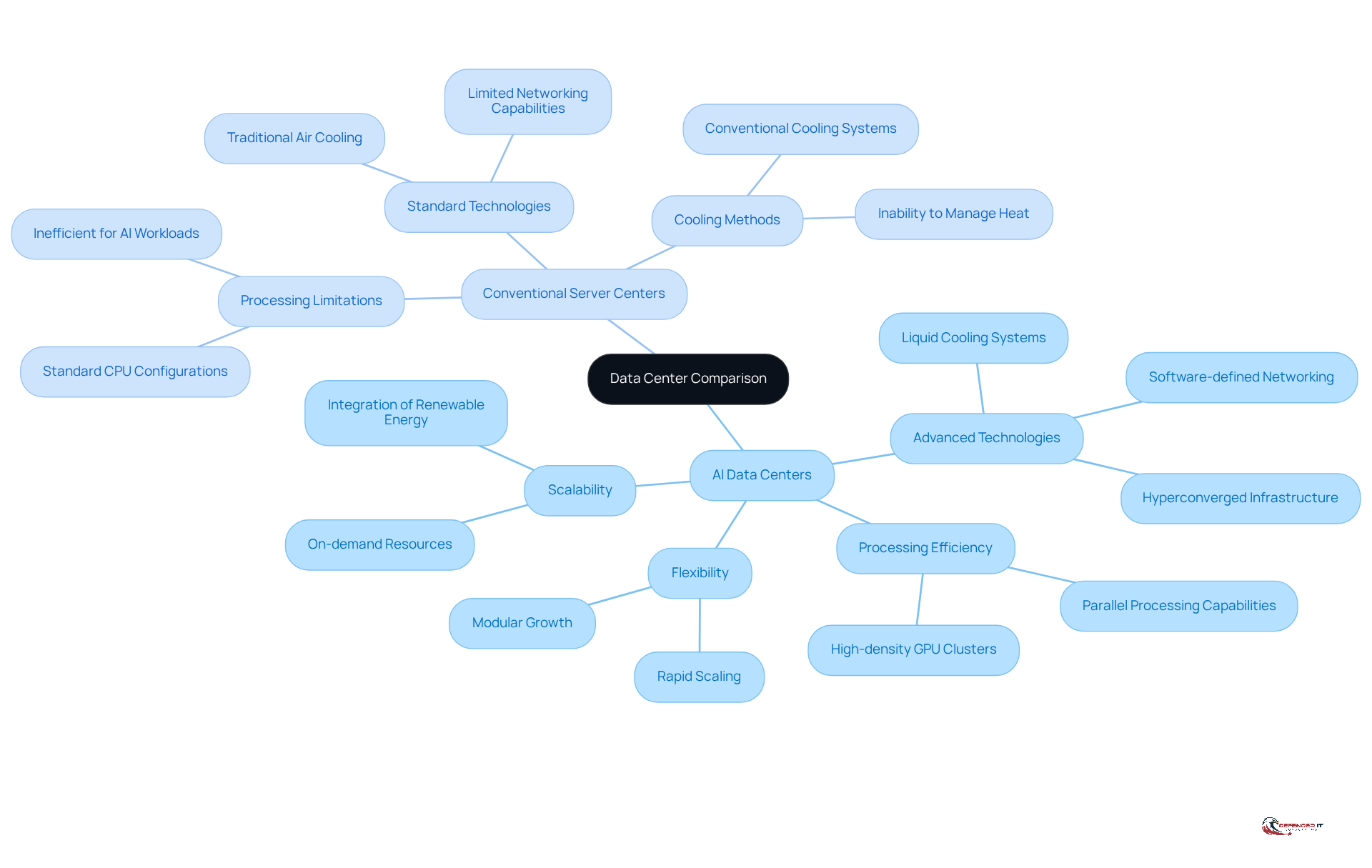
In the AI data center market, AI Centers significantly outperform conventional server centers in processing efficiency and capability for AI applications, leveraging advanced technologies like high-density GPU clusters and specialized cooling systems to process information rapidly. In contrast, Conventional Server Centers struggle to meet the demands of AI applications due to their reliance on standard CPU configurations, which are less efficient for parallel processing tasks. Moreover, traditional facilities rely on conventional cooling methods that often fail to manage the increased heat generated by AI-specific hardware.
AI Data Facilities enhance flexibility and scalability by incorporating software-defined networking and hyperconverged infrastructure, capabilities that traditional facilities often lack. As AI technology continues to evolve, the limitations of traditional facilities in the AI data center market will become increasingly apparent, necessitating a shift towards more advanced infrastructures.
Analyze Market Trends and Future Outlook
The transformation of the worldwide information hub market is being significantly influenced by the rapid growth of the AI data center market and AI technologies. According to recent reports, the AI data center market is anticipated to expand from roughly $21.27 billion in 2026 to $133.51 billion by 2034, indicating a compound annual growth rate (CAGR) surpassing 25%. This growth in the AI data center market is driven by the increasing demand for AI applications across various sectors, necessitating advanced infrastructure capable of supporting high-density workloads.
In contrast, conventional facilities are experiencing slower growth as they adapt to incorporate cloud services and hybrid models. The need for energy-efficient solutions and sustainable practices is becoming a crucial element for both types of facilities, with AI operations at the forefront of adopting innovative cooling and energy management technologies.
As organizations increasingly rely on AI for operational efficiency, the AI data center market is poised to outpace conventional facilities, necessitating a strategic reevaluation of investment strategies in information infrastructure. Significantly, AI tasks are anticipated to increase from 15% to 40% of computing workloads by 2030, emphasizing the necessity for stakeholders to adjust to this changing environment.

Evaluate Pros and Cons of Each Data Center Type
The advantages offered by the AI data center market in processing power and scalability are essential for modern AI applications. These facilities are specifically built to meet the increasing demands of the AI data center market, which requires robust computational resources. For instance, AI hyperscale facilities can demand power equivalent to 100,000 homes or more, reflecting their capacity to handle intensive workloads effectively.
However, the operational expenses associated with the AI data center market are considerably higher. This is due to the need for specialized hardware and advanced cooling systems. This investment is crucial, as the AI data center market requires extensive training of AI models using petabytes of information, necessitating immense computing power facilitated by interconnected devices and specialized processors. Additionally, the anticipated rise in electricity costs, projected to increase by an average of 8% by 2030, adds to the financial burden of managing these facilities.
In contrast, conventional facilities are typically more economical to build and sustain, making them appropriate for companies with less demanding computational requirements. They offer a more straightforward infrastructure that can adequately support standard applications. Yet, as organizations increasingly adopt AI-driven solutions, the limitations of traditional information hubs in the AI data center market are becoming more evident. These facilities may struggle to satisfy the performance requirements of modern applications, especially those dependent on the AI data center market.
The transition towards AI-oriented infrastructure in the AI data center market is further highlighted by the anticipated rise in electricity demand for facilities, which is expected to grow by 16% each year until 2028. This trend emphasizes the need for scalable and robust facilities that can adjust to the changing technological environment. Furthermore, significant environmental concerns arise regarding water consumption. Projections suggest that the AI data center market in Texas could consume up to 161 billion gallons annually by 2030, which may impact local water resources. Consequently, businesses must adapt their infrastructure strategies to leverage AI capabilities effectively, ensuring they remain competitive in a rapidly evolving digital landscape.

Conclusion
The rise of AI data centers signifies a pivotal transformation in the data center landscape, driven by the unique demands of artificial intelligence workloads. Unlike traditional data centers that focus on general computing tasks, AI data centers leverage advanced technologies and high-performance hardware to optimize processing efficiency and scalability. This shift emphasizes the critical need for organizations to adapt their infrastructure to meet the demands of AI workloads.
Throughout the article, key distinctions between AI data centers and traditional facilities have been explored. AI data centers are projected to dominate the market, with significant growth anticipated in the coming years, driven by the increasing demand for AI applications across various sectors. Traditional data centers are increasingly unable to support the performance needs of AI workloads, leading to potential operational inefficiencies. The operational costs associated with AI data centers, while higher, reflect the necessity for specialized resources to handle intensive computational tasks effectively.
As data centers evolve, stakeholders need to grasp what these changes mean for their operations. The transition towards AI-oriented infrastructure is not merely a trend but a fundamental shift that will shape the future of computing. Organizations must evaluate their investments in AI-oriented data center technologies to fully leverage AI’s potential, ensuring they are equipped to thrive in an increasingly AI-driven world. Embracing this transformation will not only enhance operational efficiency but also secure their position as leaders in the evolving digital economy.
Frequently Asked Questions
What are AI data centers?
AI data centers are specialized facilities designed to meet the unique demands of artificial intelligence workloads. They utilize high-performance hardware, such as Graphics Processing Units (GPUs) and Tensor Processing Units (TPUs), to execute complex tasks like machine learning and real-time information processing.
How do AI data centers differ from traditional data centers?
Traditional data centers cater to a broader range of general computing tasks and primarily rely on Central Processing Units (CPUs) and conventional server architectures. In contrast, AI data centers are optimized for AI workloads and utilize specialized hardware to handle complex computations.
What is the projected growth of the AI data center market?
The AI data center market is expected to grow from $43.9 billion in 2023 to nearly $1 trillion by 2032, driven by the increasing demand for generative AI.
What percentage of total storage capacity will AI facilities account for by the early 2030s?
By the early 2030s, AI facilities are projected to account for over 50% of total storage capacity.
What are the energy consumption statistics for data centers in the U.S.?
In 2023, data centers consumed roughly 4.4% of America’s electrical power, highlighting the significant energy demands associated with both AI and traditional data centers.
How might AI’s energy demands impact global electricity consumption by 2030?
AI’s energy demands could account for as much as 21% of global electricity consumption by 2030, indicating the broader implications of AI centers on energy usage and sustainability.
What operational challenges do AI infrastructure face?
Experts, such as Sean James, highlight various operational challenges faced by AI infrastructure, reflecting the evolving landscape of information centers.
List of Sources
- Define AI Data Centers and Traditional Data Centers
- Data Center World 2026: AI Pushes Infrastructure to New Limits (https://datacenterknowledge.com/build-design/data-center-world-2026-ai-pushes-infrastructure-to-new-limits)
- The future of data centers | Brookings (https://brookings.edu/articles/the-future-of-data-centers)
- 2026 Trends in Data Center Services & Infrastructure (https://spglobal.com/energy/en/news-research/special-reports/energy-transition/2026-trends-in-data-center-services-infrastructure)
- Where Is AI Data Center Demand Growth Being Driven? (https://abiresearch.com/blog/ai-data-center-demand-growth)
- Majority of US’s new AI datacenters to be built on drought-hit land (https://theguardian.com/us-news/2026/jun/08/datacenter-ai-drought-water)
- Contrast Key Features and Technologies
- AI data center vs traditional data center – what is the (https://rcrwireless.com/20250327/fundamentals/ai-data-center-difference)
- 2026 Data Center Trends: AI, Cooling & Power Insights (https://datacenterworld.com/article/2026-data-center-trends-ai-cooling-power-insights)
- Data Center Outlook 2026: Power and Cooling Challenges and Solutions Are Top of Mind (https://coresite.com/blog/data-center-outlook-2026-power-and-cooling-challenges-and-solutions-are-top-of-mind)
- AI Data Centers vs. Traditional Data Centers (https://hanwhadatacenters.com/blog/ai-data-centers-vs-traditional-data-centers)
- AI power: Expanding data center capacity to meet growing demand (https://mckinsey.com/industries/technology-media-and-telecommunications/our-insights/ai-power-expanding-data-center-capacity-to-meet-growing-demand)
- Analyze Market Trends and Future Outlook
- 2026 Data Center Trends: AI, Cooling & Power Insights (https://datacenterworld.com/article/2026-data-center-trends-ai-cooling-power-insights)
- 13 Data Center Growth Projections That Will Shape 2026-2030 – Avid Solutions (https://avidsolutionsinc.com/13-data-center-growth-projections-that-will-shape-2026-2030)
- AI Data Center Market Growth Analysis – Size and Forecast 2026-2030 (https://technavio.com/report/ai-data-center-market-industry-analysis)
- 2026 Global Data Center Outlook (https://jll.com/en-us/insights/market-outlook/data-center-outlook)
- Data Center Market Statistics 2026: AI, $416B Market & the Power Ceiling – TechnologyChecker.io (https://technologychecker.io/blog/data-center-market-statistics-ai)
- Evaluate Pros and Cons of Each Data Center Type
- The Pros and Cons of Data Centers in the Age of AI (https://quercusit.com/blog/the-pros-and-cons-of-data-centers-in-the-age-of-ai)
- Measuring the Data Center Boom: Facts and Statistics (2026) (https://programs.com/resources/data-center-statistics)
- I have just read two quotes that are worthwhile considering in the context of AI and data centres. | Edward (Ted) Pretty (https://linkedin.com/posts/tedpretty\_i-have-just-read-two-quotes-that-are-worthwhile-activity-7403670317652537346-uXvH)
- What Are the Pros and Cons of Data Centers? (https://techrepublic.com/article/news-ai-data-center-boom-costs-benefits)
- Data Centers and Their Energy Consumption: Frequently Asked Questions (https://congress.gov/crs-product/R48646)