Business
Comparing the Largest AI Data Centers: Features, Costs, and Security
Published June 28, 2026
Introduction
As artificial intelligence rapidly evolves, organizations face mounting pressure to find data centers that can support its complex demands. As they strive to leverage AI’s potential, understanding the features, costs, and security measures of the largest AI data centers becomes crucial. Organizations often struggle to navigate the complexities of selecting the right data center amidst diverse capabilities and financial implications. This lack of clarity can lead to suboptimal choices that hinder their AI initiatives.
In this article, we’ll explore a comparative analysis of leading AI data centers, providing insights to help organizations make informed decisions in this competitive landscape.
Key Features of Major AI Data Centers
Organizations face increasing challenges in managing the computational demands of artificial intelligence tasks, which necessitates the establishment of the largest AI data centers. Key features of these facilities include:
- High-Performance Computing (HPC): AI data centers utilize advanced hardware such as GPUs and TPUs to perform complex calculations at high speeds, essential for training AI models.
- Scalability: The largest AI data centers are built to scale rapidly, accommodating fluctuating workloads and expanding as demand grows. This is crucial for organizations that need to adapt quickly to changing AI requirements.
- Energy Efficiency: The largest AI data centers implement innovative cooling solutions and energy management systems to optimize power usage, which is crucial considering the high energy demands of AI processing.
- Advanced Networking: High-speed interconnects and low-latency networking are essential for ensuring that information can be processed and transferred efficiently across the largest AI data centers.
- Robust Security Measures: Given the sensitive nature of information processed, the largest AI data centers incorporate advanced security protocols, including physical security, cybersecurity measures, and compliance with industry standards.
These features collectively ensure that organizations can effectively harness the power of AI in the largest AI data centers while addressing the inherent challenges. Without these advancements, organizations risk falling behind in the rapidly evolving landscape of artificial intelligence.

Cost Analysis of Leading AI Data Centers
Navigating the financial landscape of AI facilities presents significant challenges and opportunities for organizations. Key cost considerations include:
- Capital Expenditures (CapEx): Establishing an AI data center demands substantial upfront investment, often exceeding $10 million and potentially reaching over $500 million, depending on the scale and technology employed. While specific figures for a one-gigawatt AI facility are not detailed in the sources, the overall capital expenditure estimates for developers have been significantly revised upward, with projections nearing $750 billion in 2026. This reflects the significant financial commitment necessary for advanced AI capabilities.
- Operational Expenditures (OpEx): Ongoing expenses, including electricity, maintenance, and staffing, make up a significant portion of the budget. As energy prices rise, organizations must prepare for the impact on their operational expenses for the largest AI data centers. Reports indicate that these increasing energy prices will require meticulous financial planning to manage the expected rises in electricity usage.
- Expense of Compliance: Meeting regulatory standards can further elevate operational expenses, as organizations must invest in security measures and conduct audits to ensure adherence to industry regulations. This compliance-related expenditure is critical for maintaining operational integrity and avoiding potential penalties.
- Return on Investment (ROI): Despite the high initial expenses, the potential for improved efficiency and the strategic benefit gained from utilizing AI can result in substantial long-term savings and revenue generation. Organizations that successfully navigate these costs can unlock significant efficiencies and revenue opportunities, positioning themselves advantageously in the market. Additionally, the projected investment required for AI demand is estimated at $5.2 trillion by 2030, underscoring the urgency for substantial investment in AI infrastructure.

Security Measures in Prominent AI Data Centers
As AI facilities become increasingly integral to operations, the need for robust security measures has never been more critical. To effectively safeguard both physical and digital assets, AI facilities implement several key security measures:
- Physical Security: This encompasses access controls, surveillance systems, and environmental controls designed to protect against unauthorized access and physical threats.
- Cybersecurity Protocols: Advanced cybersecurity measures, including firewalls, intrusion detection systems, and encryption, are employed to shield information from cyber attacks.
- Zero Trust Architecture: Many AI information hubs adopt a zero trust model, ensuring that all users and devices are authenticated and authorized before accessing resources, thereby minimizing the risk of breaches.
- Compliance with Standards: Adherence to industry standards such as ISO 27001 and the NIST Cybersecurity Framework is essential for ensuring that security practices meet regulatory requirements and best practices.
- Incident Response Plans: Effective incident response plans are crucial for addressing security breaches swiftly and minimizing potential damage, including regular drills and updates to response protocols.
Without these measures, organizations risk significant vulnerabilities that could compromise their operations and data integrity.

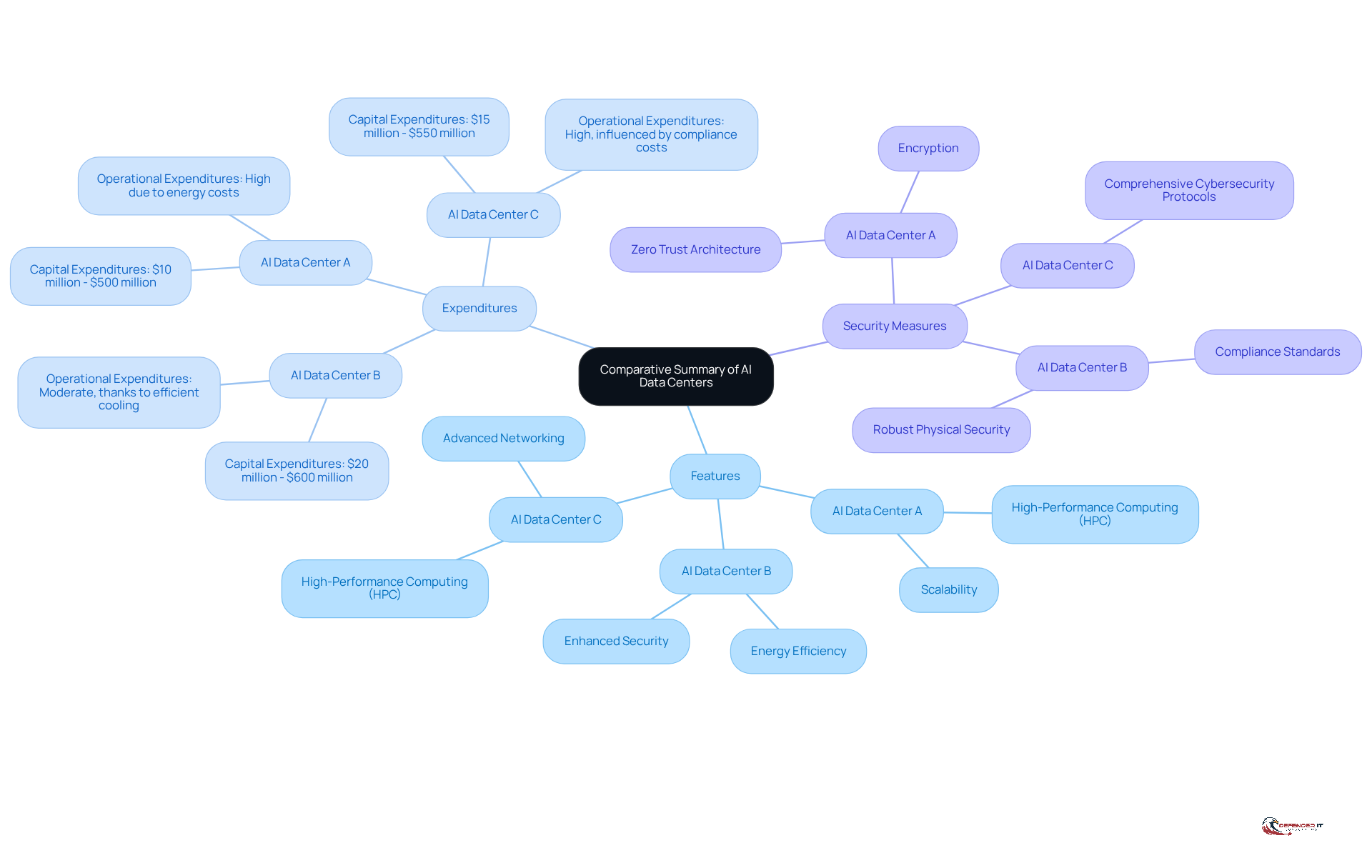
Comparative Summary of AI Data Centers
The comparison of major AI data centers reveals critical insights into their operational capabilities and environmental impacts, particularly in light of the projected increase in AI workloads, which are expected to account for a significant portion of total data center computing by 2030:
-
Feature/Aspect
- AI Data Center A: High-Performance Computing (HPC), Scalability
- AI Data Center B: Energy Efficiency, Enhanced Security
- AI Data Center C: Advanced Networking, High-Performance Computing (HPC)
-
Capital Expenditures (CapEx)
- AI Data Center A: $10 million – $500 million
- AI Data Center B: $20 million – $600 million
- AI Data Center C: $15 million – $550 million
-
Operational Expenditures (OpEx)
- AI Data Center A: High due to energy costs
- AI Data Center B: Moderate, thanks to efficient cooling
- AI Data Center C: High, influenced by compliance costs
-
Security Measures
- AI Data Center A: Zero Trust Architecture, Encryption
- AI Data Center B: Robust Physical Security, Compliance Standards
- AI Data Center C: Comprehensive Cybersecurity Protocols
This comparison provides a clear framework for organizations to assess which facility aligns best with their operational requirements and security needs. Organizations must also consider the environmental challenges associated with data centers, particularly their significant water consumption and effects on local resources. Experts point out that the rapid expansion of the AI industry is increasing water demand in drought-stricken areas, prompting urgent discussions about sustainability. Addressing these environmental concerns is essential for ensuring the sustainability of AI data centers in the future.
Conclusion
Organizations aiming to leverage artificial intelligence must navigate a complex landscape defined by critical features, substantial costs, and robust security measures. Understanding these elements is essential for making informed decisions about infrastructure investments that can drive innovation and efficiency.
Key insights from the comparative analysis highlight the importance of:
- High-performance computing
- Scalability
- Energy efficiency
- Advanced networking capabilities
in leading AI data centers. Additionally, the financial implications, including capital and operational expenditures, underscore the need for careful budgeting and strategic planning. Security measures, such as zero trust architecture and compliance with industry standards, are paramount in safeguarding sensitive data and maintaining operational integrity.
With the surging demand for AI capabilities, organizations must not only focus on technological and financial aspects but also consider the environmental impact of their operations. Embracing sustainable practices and addressing water consumption challenges will be crucial for the long-term viability of AI data centers. By prioritizing these considerations, organizations can not only lead in AI innovation but also ensure their operations are sustainable and responsible.
Frequently Asked Questions
What are the key features of major AI data centers?
The key features of major AI data centers include High-Performance Computing (HPC), scalability, energy efficiency, advanced networking, and robust security measures.
How does High-Performance Computing (HPC) benefit AI data centers?
HPC benefits AI data centers by utilizing advanced hardware such as GPUs and TPUs to perform complex calculations at high speeds, which is essential for training AI models.
Why is scalability important for AI data centers?
Scalability is important for AI data centers because it allows them to accommodate fluctuating workloads and expand as demand grows, enabling organizations to adapt quickly to changing AI requirements.
What measures do AI data centers take to ensure energy efficiency?
AI data centers implement innovative cooling solutions and energy management systems to optimize power usage, which is crucial due to the high energy demands of AI processing.
What role does advanced networking play in AI data centers?
Advanced networking, including high-speed interconnects and low-latency networking, is essential for ensuring efficient processing and transfer of information across AI data centers.
What security measures are implemented in AI data centers?
AI data centers incorporate advanced security protocols, including physical security, cybersecurity measures, and compliance with industry standards, to protect sensitive information processed within them.
List of Sources
- Key Features of Major AI Data Centers
- AI Data Centers Recent News | Data Center Knowledge (https://datacenterknowledge.com/next-gen-data-centers/ai-data-centers)
- The 8 Data Center Trends That Will Define 2026 (https://arctiq.com/blog/the-8-data-center-trends-that-will-define-2026)
- AI Data Centers Push Tech Innovation to New Limits (https://designnews.com/electronics/ai-data-centers-stretch-tech-innovation-limits)
- Top 10 Data Center Industry Trends in 2026 (https://tierpoint.com/blog/data-center/data-center-industry-trends)
- 2026 Data Center Trends: AI, Cooling & Power Insights (https://datacenterworld.com/article/2026-data-center-trends-ai-cooling-power-insights)
- Cost Analysis of Leading AI Data Centers
- The cost of compute: A $7 trillion race to scale data centers (https://mckinsey.com/industries/technology-media-and-telecommunications/our-insights/the-cost-of-compute-a-7-trillion-dollar-race-to-scale-data-centers)
- Data Center Capex Boom on AI (https://eetimes.com/data-center-capex-boom-on-ai)
- AI Data Center Build Advances at Full Speed: Five Things to Know | BloombergNEF (https://about.bnef.com/insights/data-centers/ai-data-center-build-advances-at-full-speed-five-things-to-know)
- Security Measures in Prominent AI Data Centers
- What is an AI data center? Key capabilities explained | Fortinet (https://fortinet.com/resources/cyberglossary/ai-data-centers)
- A CISO’s Security Predictions for Data Centers in 2026 (https://databank.com/resources/blogs/a-cisos-security-predictions-for-data-centers-in-2026)
- Data Centers Confront Rising Cyber and Physical Security Threats (https://news.bloomberglaw.com/privacy-and-data-security/data-centers-confront-rising-cyber-and-physical-security-threats)
- AI Data Centers & Cyber Risk: Power Demand Creates Security Gaps (https://denexus.io/resources/ai-data-centers-cyber-risk-power-demands-security-vulnerabilities)
- Accelerating AI Data Center Security, Institute for AI Policy and Strategy (https://iaps.ai/research/accelerating-ai-data-center-security)
- Comparative Summary of AI Data Centers
- AI Data Centers Recent News | Data Center Knowledge (https://datacenterknowledge.com/next-gen-data-centers/ai-data-centers)
- Measuring the Data Center Boom: Facts and Statistics (2026) (https://programs.com/resources/data-center-statistics)
- Majority of US’s new AI datacenters to be built on drought-hit land (https://theguardian.com/us-news/2026/jun/08/datacenter-ai-drought-water)
- AI Data Centers Are Coming for Your Land, Water and Power (https://cnet.com/tech/services-and-software/features/ai-data-centers-are-coming-for-your-land-water-and-power)